Giordano Buondonno, Piano
June 26th, 2026
The Programme
An established international concert pianist, Giordano presents a programme including works by Bach, Beahms, Debussy and Rachmaninov.
Concert Programme
Johannes Brahms (1833-1897)
Ballades Op.10
- D minor. Andante
- D major. Andante
- B minor, Intermezzo. Allegro
- B major. Andante con moto
Achille-Claude Debussy (1862-1918)
Images Book 1
- Reflets en l’eau (Reflections in the water)
- Hommage à Rameau (Tribute to Rameeau)
- Mouvement
Interval – 20 Minutes
Achille-Claude Debussy
Images Book 2
- Cloches à travers les feuilles (Bells through the leaves)
- Et la lune descend sur le temple qui fut. (And the moon descends on the temple that was)
- Poissons d’or (Gold fish)
Sergei Vasileyvich Rachmaninov (1873-1943)
Etudes Tableaux. Op.33
- Allegro non troppo
- Allegro
- Grave
- Moderato
- Non allegro – Presto
- Allegro con fuoco
- Moderato
- Grave
Johanne Sebastien Bach (1685-1750) Transcribed Ferruccio Busoni (1866-1924)
Toccata and Fugue in D minor
Programme Notes
The Ballades Op.10 are a product of the youthful composer, dedicated to his friend Julius Otto Grimm, and coincided with the beginning of Brahms’s affection for Clara Schumman. Clara went a long way to help Brahms launch his career as composer and pianist. The music sits in pairs – D minor/D major and then B minor/B major. There is no specific connection any poems except with the first Ballade, inspired by a Scottish poem “Edward”, found in a collection by Johann Gottfried Herder.
Debussy wrote 3 collections of Images – 2 for piano and one orchestral. The piano compositions were written between 1901 and 1905 (book 1) and in 1907 (Book 2). Debussy wrote to his publisher, Jacques Durnand, about the 1st book, “without false pride, I feel that these pieces hold together well, and that they will find their place in the literature of the piano …..to the left of Schumann, or to the right of Chopin.” These beautiful pieces are prime examples of what became known as musical impressionism. On a personal note, it reminds me of fierce argument with an art teacher who was appalled at the thought of musical sound creating images and colours. That Debussy’s music does evoke such images is beyond doubt, but how he does it is part of the magic and mystery of his musical language.
The influential Russian pianist and teacher, Sergei Dorensky, once told me that he regarded Rachmaninov as the last great genius of the piano. An interesting remark and one difficult to refute. Like all the great pianist composers before him, Rachmaninov was one of the finest executants of his time. He recorded much of his piano catalogue including the 4 concertos, creating the benchmark for all future interpretations. He left Russia after the revolution in 1918, living in New York. From this point until his death in 1943, Rachmaninov spent his time performing throughout the USA and Europe, composing little.
The Etudes Tableaux have been described as musical explorations. The were composed in 1911 and are not, like the Debussy Images, musical pictures but musical explorations in sound and textures made possible on the piano. They are also a test, being études, of the player’s technique and virtuosity!
Sig. Busoni was famed for his piano transcriptions of Bach’s organ works. Excellent piano music but frowned upon by organists!
Programme Notes Copywrite Alistair Jones, 2026
The Artist
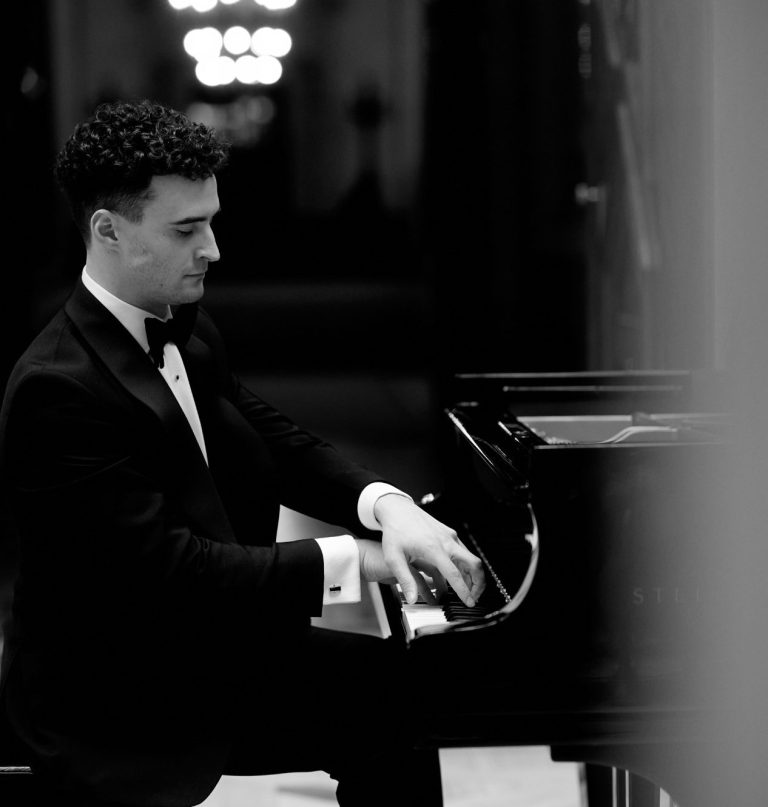
Giordano Buondonna
Born in La Spezia, Italy, Giordano Buondonno graduated with highest honours from the Giacomo Puccini Conservatoire, earning top marks in his class. He went on to refine his artistry under the mentorship of renowned pianists Sergio De Simone, Deniz Gelenbe, Mikhail Kazakevich, and Martino Tirimo at Trinity Laban Conservatoire in London, where he completed both a Master in Performance and an Artist Diploma.
He later pursued further studies at the Guildhall School of Music and Drama, where he was awarded a second Artist Diploma under the guidance of Ronan O’Hora, Charles Owen, and Noriko Ogawa. At the age of 19, Giordano was awarded first prize at the Clara Schumann Competition. A laureate of the PianoLink Concerto Competition, he earned first prize with a performance of Chopin’s Piano Concerto No. 1, accompanied by the PianoLink Philharmonic Orchestra under the baton of Massimo Fiocchi Malaspina at Palazzina Liberty in Milan. He was a finalist in the 2019 Beethoven Society Intercollegiate Piano
Competition and won third prize at the Sheepdrove Intercollegiate Piano Competition.
Giordano’s international debut in Russia featured a three-concert tour as part of the Pianissimo Winter Festival. His performances included appearances at the Hermitage Museum in St. Petersburg, the GES-2 Concert Hall in Moscow, and the Pakgauzy Concert Hall in Nizhny Novgorod.
Notable highlights of Giordano’s career include recitals at Steinway Hall, King’s Place Hall, Milton Court Concert Hall at the Barbican Centre, St. James’s Piccadilly in London, as well as a performance at Henley Park Manor in Surrey for His Serene Highness Prince Donatus von Hohenzollern.
He has also performed in Rome as part of the Young Artist Concert Series organized by RomaTre Orchestra. Recent engagements include appearances at the South Hill Park Arts Centre International Conservatoire Series, Lighthouse Poole’s Centre for the Arts, George Solti Studio in London (performing on Arturo Benedetti Michelangeli’s piano), the Paganiniano Festival in Italy, Old Royal Naval College, St. Alfege Church, the Polish
Hearth Club in South Kensington, and St. Mary’s Perivale.
Giordano is a proud recipient of numerous scholarships and awards, including The
Leverhulme Trust Scholarship, Arthur Haynes Scholarship, Gladys Bratton Scholarship, two Jacqueline Williams Scholarships, and support from The Keyboard Charitable Trust in London.