Milen Earath, Piano
September 25th, 2026
The Programme
Milen Earath was introduced to the piano at the age of 9, by 14 he was a Licentiate of Trinity College, London (LTCL) with distinction. It will be a rare treat to hear a player of such prodigous talent.
Johann Sebastian Bach (1685-1750)
Partita No. 6 in E minor, BWV 830
- Toccata
- Allemanda
- Corrente
- Air
- Sarabande
- Tempo di Gavotta
- Gigue
Richard Wagner / Ferencz Liszt (1811-1886)
- Isoldes Liebestod (from Tristan und Isolde)
Interval – 20 minutes
Joseph Maurice Ravel (1875-1937)
- Gaspard de la nuit
- Ondine
- Le Gibet
- Scarbo
Vincenzo Bellini (1801-1835)/ Liszt
- Réminiscences de Norma
Programme Notes
It is a fact that most of the composers who wrote extensively for the keyboard, be it harpsichord, organ or piano, were exceptional executants. This is certainly true of this evening’s 3 composers, Bach, Liszt and Ravel. Bach composed a huge amount of important music for the organ and the harpsichord. No-one has written finer music for the organ with his Preludes and Fugues, Toccatas, the 6 Trio Sonatas, the monumental Passacaglia and Fugue in C minor, and many, many Chorale Preludes. In my organ student days, my teachers were unanimous in selecting our repertoire; each lesson was Bach and something else.
The importance of his 2 Volumes of keyboard Prelude and Fugues under the title of “Well Tempered Clavier” are of huge importance, expanding the realm of all 24 major and minor keys. In addition, there are the keyboard Suites (English and French) and the 4 Volumes, published in the composer’s lifetime, entitled Clavier-Ûbung (keyboard practice). The 6 Partitas were grouped together in the 1st volume. Unlike the English and French Suites, the Partitas are more wide ranging in the choice of titles and style of the movements. They are also aimed at a more proficient performer.
Of Bach himself, his first biographer, Johann Niklaus Forkel (1749-1818), wrote: “ John Sebastian Bach’s manner of managing the clavier was admired by all those who had the good fortune to hear him, and envied by all those who might themselves claim to be considered as good performers”.
I have written many times before about Franz Liszt as the father of the Piano Recital. When Liszt began to promote himself as a great piano virtuoso. He began to fill his recital programmes with new works of his own composing. This was a matter of necessity. However interesting it might have been to hear this extraordinary exponent perform Beethoven sonatas, he needed new music and Liszt was leader of the new, developing language of music. He wrote piano diaries of his travels in the Années de Pèlerinange (Years of Pilgrimage), arrangements of Schubert songs and, as we will hear this evening, transcriptions from operas. All demonstrated the composer’s remarkable virtuoso technique.
When Wagner married Cosima von Bülow, Wagner became Liszt’s son-in-law! Liszt transcribed a number of pieces from Wagner’s operas for piano solo, Isolde’s final outpouring in Act 3 of the opera that bears her name, is one of the most famous. Liszt also turned to the new Italian operas of Bellini and Mozart. The Norma Réminiscences is one of the most challenging for the pianist and prominently feature the famous aria “Casta Diva”, made famous to contemporary audiences by Maria Calas and Joan Sutherland, amongst others.
Music of supreme difficulty was not the sole reserve of Liszt. In composing his Trois poèmes pour piano d’après Aloysius Bertrnad, Ravel set out to write a piece that was more difficult Balakirev’s Islamey – another work that challenges the pianist’s technique to the limit. While Ravel’s Gaspard is difficult it is also a wonderful set of 3 musical poems, each proffering a musical scene to the listener. Ondine is the musical nymph; Le Gibet with its repeated notes shows us the rope on the gallows swinging in the wind and Scarbo brings us to the world of the mischievous and evil Goblin of night time dreams.
Programme Notes Copyright Alistair Jones, 2026
The Artist
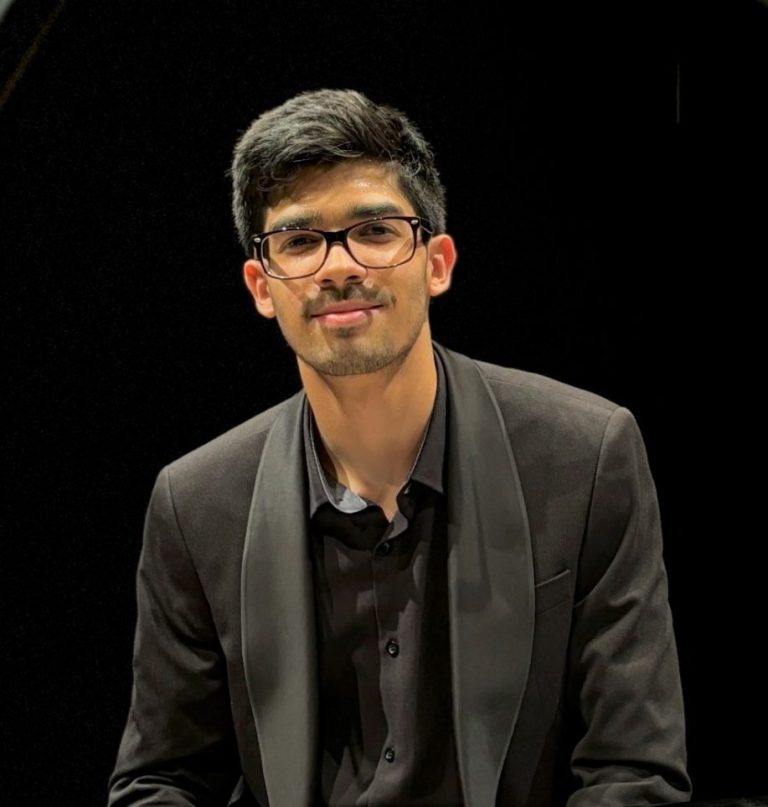
Milen Earath
MilMilen Earath was born in the southern Indian state of Kerala to a family of doctors with no formal musical background. He began playing the piano after a formative visit to his grandparents in Russia, where he first encountered classical music in 2010. On returning to India, he began formal training and progressed rapidly through Trinity College London’s piano curriculum, completing all eight grades and earning the ATCL, LTCL, and FTCL diplomas with distinction by 2015. He is considered one of the youngest Indian pianists to achieve these qualifications within just four and a half years.
Milen made his competition debut in 2013, aged twelve, winning the Advanced Division at the MusiQuest Competition in Pune, India. The following year, he received the Audience Favourite Prize and was a semi-finalist at the Conbrio Competition in Mumbai. Following these successes, he was invited to study with Professor Heribert Koch, President of the European Piano Teachers Association, attending regular masterclasses in Germany while continuing independent study in India. Since then, he has performed in Germany, Russia, Belgium, Italy, and the United Kingdom.
HMilen gave his first solo recital in 2016 at Schloss Burgau, Germany, and made his orchestral debut later that year performing Mendelssohn’s Piano Concerto No. 1. In November 2016, he was awarded the National Child Award for Exceptional Achievement in Music by the President
of India, Pranab Mukherjee. In 2017, he gave a major solo recital at the National Centre for the Performing Arts in Mumbai and performed for Her Majesty Queen Mathilde of Belgium at the Mehli Mehta Music Foundation. In 2018, he performed Liszt’s Piano Concerto No. 2 with Collegium Musicum Jülich under conductor Peter Sauerwein.
From 2019 to 2024, Milen undertook intensive study with Professor Tatiana Zelikman, completing the five-year Specialist Diploma in Piano Performance at the Gnesin Russian Academy of Music in Moscow, graduating with First-Class Honours. In June 2026, he completed the Master of Performance at the Guildhall School of Music & Drama under Professor Ronan O’Hora. During his studies at Guildhall, he was a finalist in the School’s 2024 Beethoven Prize, 2025 Romantic Prize, and the prestigious 2026 Gold Medal Competition at the Barbican. He was also awarded Second Prize and the Audience Prize at the 2026 Cambridge International Piano Competition.
Milen is a recipient of scholarships from the Guildhall School of Music & Drama, Steinway & Sons, the Leverhulme Arts Trust, and the Jesse Wakefield Bursary. Milen is currently pursuing the Advanced Artist Diploma at Guildhall, continuing his studies with Professor Ronan O’Hora.