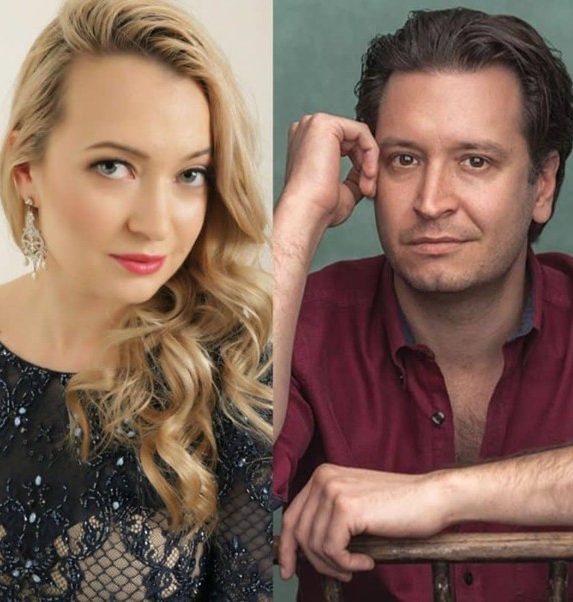
Natasha Day, Soprano & David Malusa, Piano
September 26th, 2025
The Programme
This husband-and-wife duo takes us into the world of opera and solo song. They offer songs by Schubert and Richard Strauss – 2 of the greatest of all the German composers of Lieder, together with favourite arias from operas by Puccini, Verdi, Dvorak and Korngold. You should really come and hear this fabulous duo!
Franz Seraph Peter Schubert (1797-1828)
3 Lieder
- Ständchen (Serenade)
- Der Zwerg (The Dwarf)
- Im Abendrot (At sunset)
Schumann/Liszt
- Widmung
Richard Georg Strauss (1864-1949)
5 Lieder
- Zueignung
- Allerseelen
- Fruhlingsfeier
- Morgen
- Cãcilie
Interval - 20 minutes
Erich Wolfgang Korngold (1897-1957)
- Marietta’s Lied from “Die Tote Stadt” (The Dead City)
Giacomo Puccini (1858-192)
- Visi d’arte (from Tosca)
- O mio babbino caro (from Gianni Schicchi)
Frédéric François Chopin (1810-1849)
- Polonaise Héroique
Antonín Leopold Dvorák (1841-1904)
- Song to the Moon (from Rusalka)
- Giuseppe Fortunino Franceso Verdi (1813-1901)
- Surta a. la notte …..Ernani, Involami ….Tutto sprezzo che d’Ernani (from Ernani)
Programme Notes
Welcome to the opening concert of our 13th Season. And what an opening it is going to be with international soprano Natasha Day and her husband, concert pianist David Malusa. They have devised a wonderful programme of German Lieder, opera Arias and Piano classics; indeed, something for everyone.
The first part of the programme is given overt to songs by 2 of Germany’s greatest composers of the Lied. Schubert wrote more than 600 songs in his short life. The flood of song writing began in 1814 with “Gretchen at the Spinning Wheel.” In 1815 he composed 144 songs, including 8 in one day! He revolutionised the role of the piano in his songs – it was no longer a mere accompaniment, but provided a musical partner, sometime describing a mood or something more tangible. In the song “Der Zwerg” the piano describes the lapping of water against the side of the boat, while also providing a harmonic cushion for the vocal line. In “Ständchen” it is the guitar of the serenader.
Liszt is, of course, famous as a virtuoso pianist and the composer of difficult piano works. As the father of the Piano Recital, he populated his concert programmes with arrangements of other composers’ vocal and operatic works. Famous amongst these is this fine arrangement of Schumann’s song “Widmung” (Devotion).
Further along in the history of German Lieder is Richard Strauss. Famous for his orchestral Tone Poems – Don Juan, Till Eulenspiegel, Ein Heldenleben et al. and his operas – Salome, Elektra, Der Rosenkavalier and many others, he was a prolific composer of Lieder. In the selection chosen by Natasha, you will hear the composer’s never ending melodic style (he was in love with the soprano voice) and a fuller piano part reminiscent of Schumann. Amongst Natasha’s selection, “Zueignung” (Devotion`) has an interesting history. This song, along with “Allerseelen, was in the composer’s Op.10 collection and the first songs of Strauss to be published. “Zueignung” was orchestrated twice, once by conductor Robert Heger and by Strauss himself. In Strauss’s own version he added a line for soprano Viorica Ursuleac, “Du wunderbare Helena” as a thanks for Ursuleac’s singing of the title role in his opera “Die ägytische Helena” at the Salzburg Festival in 1933. The composer also recorded the song 3 times with himself at the piano.
After the Interval, we enter the world of Grand. Opera. From the vast repertoire on offer, Natasha has selected arias from Germany, Italy and Bohemia. Korngold’s “Die tote Stadt” was a wild success in its day but, owing to Korngold’s Jewish heritage, it was banned by the Nazis. Lately it as received revivals in Vienna, New York and Berlin. In 2009 it was staged at the ROH and in 2023 by English National Opera at the London Coliseum. Marietta’s song from Act 1 remains the most famous aria from this fine opera.
After a slow start, Puccini became one of Italy’s most successful opera composers, alongside Verdi. In Tosca, our eponymous heroine is caught in a disastrous love triangle with her lover, Cavaradossi and the evil head of the secret police, Baron Scarpia. It finds Puccini at his most dramatic. Tosca, in Act 2, is given an impossible choice between her virtue (!) and the life of her tortured lover. Quite different is Puccini’s comic creation in “Gianni Schichii”. Our heroine here pleads with her father to let her marry the man she loves.
To give our Diva some breathing space, David performs one of Chopin’s most famous compositions, the Heroic Polonaise. It is one of the composer’s most admired compositions – and very difficult, written in 1842 and published 1 year later. Listen out for the left hand in the middle section!
The name Dvorák is not immediately associated with opera. In his early years he gained experience of the genre playing viola in pit orchestras. So he knew the operatic works of Mozart, Weber, Rossini, Wagner and Verdi. Composing “Rusalka” came in the composer’s last years. A success in his native land, it struggled to survive elsewhere in Europe and the USA. The story of “Rusalka: has been descried as a “sad fairy tale” – the beautiful “Song to the Moon” is the opera’s most famous moment.
Verdi was not just a composer of operas, he was an Italian hero. The chorus of Slaves from the opera “Nabucco” was a rallying cry at the time of Italian Unification. “Ernani” is a drama of love and political fighting. The heroine, Elvira, in love with Ernani, is one of Verdi’s most dramatic roles for the soprano.
Programme Notes Copywrite Alistair Jones, 2025
The Artists
Natasha Day
Scottish-Polish soprano Natasha Day won a scholarship to the Royal College of Music from where she graduated with First Class Honours. A recipient of the Midori Nishiura Award, she studied on the Postgraduate course at the RCM and went on to train at the English National Opera on the ‘Opera Works’ course. She then completed her studies at the RCM’s International Opera School (RCMIOS), where she was a Fishmongers' Company Scholar supported by a Robert McFadzean Whyte Award.
Natasha won First Prize at the Złote Głosy Competition in Warsaw, Second Prize at The Filharmonia Czestochowska Competition also in Poland and The Most Promising Singer Award at the Emmy Destinn Competition in Prague. She was a Finalist in the Concorso Lirico di Ferrara, Italy and is a Britten-Pears Young Artist.
Future 2020 performances include the title role of Tosca (Opera Brava), the title role in Moniuszko’s Halka (Polish Opera in London, POSK), Mimi La Boheme (Devon Opera) plus various recitals, oratorios and opera gala concerts around Scotland, England and Poland.
David Malusa
David Malusà studied the piano at the Conservatorio Arrigo Pedrollo in Vicenza and the Royal College of Music in London; he worked with Leonid Margarius and Vincenzo Balzani at the former, and Neil Immelman and Vanessa Latarche at the latter. He then proceeded to win prizes at Città di Carrara, Città di Cortemilia, Città di Cantalupa, the Paul Hindemith International Piano Competition, and the Jaques Samuel Intercollegiate Piano Competition. Most recently, David won 2nd Prize at Second prize at the 5th International ClaMo Piano Competition.
David Malusà’s performing career took off following his victory at the Jaques Samuel Intercollegiate Piano Competition, and his ensuing recitals at the Fazioli Concert Hall and Wigmore Hall drew critical acclaim (you can purchase a live recording of his Wigmore Hall recital).
David performs regularly as a soloist and in chamber music settings, and he is represented by South Wales-based Gunnar Management.