Christos Fountos - July 25th, 2025
The Programme
- Haydn - Sonata in D major, Hob.XVI:24
- Scarlatti - Sonata in G minor K35 & Sonata in G Major K455
- Busoni - Two Preludes from op.37, no.17 & 21
- Interval
- Ravel – Gaspard de la Nuit
- Brahms – Piano Sonata no.3 in F minor
Concert Programme
Guiseppe Domenico Scarlatti (1685-1757)
Sonata in G minor, K35
Sonata in G major, K455
Ferruccio Dante Michelangiolo Benvenuto Busoni (1866-1924)
Two Preludes from Op.37
- No.17 in A flat – Allegretto vivace
- No.21 in B-flat – Andantino sostenuto
Joseph Maurice Ravel (1875-1937)
Gaspard de la Nuit
- Ondine
- Le Gibet
- Scarbo
Interval
Johannes Brahms (1833-1897)
Piano Sonata No.3 in F minor
- Allegro maestoso
- Andante espressivo
- Scherzo – Allegro energico avec trio
- Intermezzo – Andante molto – “Rückblick” – (Remembrance)
- Finale. Allegro moderato ma rubato
Haydn’s Piano Sonatas number 62! They span the years when the sonatas appeared “for harpsichord or Pianoforte” through to the years when the instrument was developed further into the realm of the piano as an instrument expressive by touch. The Sonata in D, composed in 1773, was published in 1774 as part of 6 Sonatas, Op.13 and dedicated to Haydn’s employer, Prince Nicholas Esterhazy. For analysis, it presents no problems. Just enjoy it.
Domenico Scarlatti is one of 3 famous names born in 1685, the other 2 being Bach (JS) and Handel. It was quite a year! Between them they produced a huge amount of music. Domenico Scarlatti’s life began in Naples, from whence he went to Venice (for lessons) and where he met the young Handel. Handel’s patron in Rome, Cardinal Ottoboni arranged a friendly competition between the 2 – Handel was judged the better organist, Scarlatti the better harpsichordist. Scarlatti obtained various musical posts in Rome but spent the majority of his career in the employ of the Portuguese Royal family. From 1719-28 he was the teacher of Princess Maria Barbara, for whom he composed more than 550 one movements sonatas. While these were interesting as music, they were also for the Princess studies in various finger and hand techniques. The have remained important in the history of keyboard music.
Busoni, he of the impossibly long name, was one of the most fascinating figures in musical history. He was an admired piano virtuoso and teacher as well as a notable and influential composer and conductor. He was a great admirer of the music of JS Bach, whose works he transcribed for the modern piano. His virtuosity looked back to the music of Liszt and his compositions looked forward to Bartok and others. His catalogue of compositions is large crossing all genres. Sadly, his opera Dr. Faust, was incomplete at his death, but completed by various musicians. His vast and very difficult Piano Concerto is much admired, with its unusual choral ending. His Preludes Op.37 are from his teenage years, but, while following the traditional key scheme of all 24 major and minor keys, the musical style is all his own flowing from the world of romanticism.
Ravel composed his 3 movement Suite, Gaspard de la Nuit, in 1908. The musical pictures are based on poems by Aloysius Bertand. The work is noted for its difficulty, Ravel intending that the 3rd piece, Scarbo, should be harder than Balakirev’s Islamey. Ravel said of the work, “Gaspard has been a devil in coming, but that is only logical since it was he who is the author of the poems. My ambition is to say with notes what a poet expresses with words.” So, it is all about the devil and his tricks.
Brahms was just 20 when he completed this 3rd Piano Sonata. Unusually it is in 5 and not 4 movements. Brahms was a great devotee of Beethoven, and in form this Piano Sonata, Brahms’s last, is inline with classical tradition but imbued with the free spirit of the Romantic period. You hear this in the flow of the composer’s melodic ideas and the wonderful way in which he exploits his tunes. That Brahms was himself a fine pianist is evident in every bar of music.
Programme Notes Copywrite Alistair Jones, 2025
The Artist
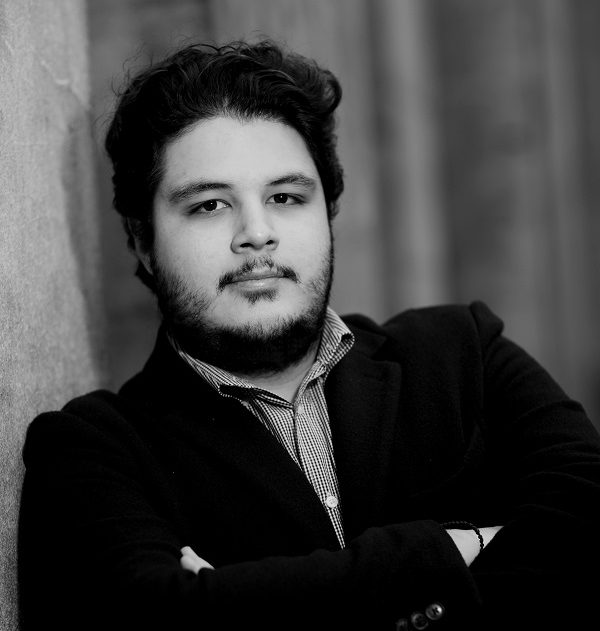
Christos Fountos was born in Nicosia, Cyprus in 1997 and he started taking piano lessons at the age of 5 under Prof. Miroslav Gospodinov. At age 17 he debuted as soloist with the Cyprus Symphony Orchestra and a year later he started his studies at Trinity Laban Conservatoire of Music and Dance in London under Philip Fowke, Sergio de Simone and Martino Tirimo where he graduated with top marks and various awards.
He lives in London and he is active as a teacher and performer, giving concerts regularly as soloist with various orchestras, chamber music mainly with his trio, the "Waldstein Trio" which has recently performed in France, Malta, Vienna (Musikverein), Cyprus and Canada (Banff Music Centre), as accompanist in vocal recitals and in solo concerts. The Trio has won the following prizes: 2nd Prize - Cavatina Chamber Music Competition in Wigmore Hall, 1st prizes at the 4th Vienna International Music Competition and International "Medici" Music Competition.
In his recent concerts he has performed among others Rachmaninoff's Piano Concertos nos. 1&3, and a series of chamber music works. Future concerts include Rachmaninoff's Piano Concerto no.2 and Tchaikovsky's Piano Concerto no.1. Besides music, he has a passion for poetry