Margrit Hasler, Viola & Rosie Richardson, Piano
January 23rd, 2026
The Programme
Johann Sebastian Bach (1685 - 1750)
- Viola da gamba sonata in G major BWV 1027
Benjamin Britten (1913 - 1976)
- Lachrymae for Viola and Piano Op.48 - 'Reflections on a song of Dowland’
Interval (20 minutes)
Johannes Brahms (1833 - 1897)
- Viola Sonata in F minor Op. 120 No 1
- Allegro appassionato
- Andante un poco adagio
- Allegretto grazioso
- Vivace
Programme Notes
Bach’s career as a composer can be easily divided into the years of employment as a professional musician. From 1708, Bach was organist and court musician to Duke Wilhelm Ernst of Weimar. Many of Bach’s finest organ works date from this period. Also some early church cantatas. In 1717 Bach was offered the post of Kapellmeister to Prince Leopold of Anhalt-Cöthen. A strict Calvinist, the Prince required no music for his chapel but maintained a lively collegium musicum – a musical ensemble, giving Bach the opportunity to compose instrumental works. It is here that he composed the first book of the Well-Tempered Clavier, various instrumental sonatas and keyboard suites and the six Brandenburg Concertos. Prince Leopold was an able played on the violin, bass viol and harpsichord. It was for him that Bach almost certainly composed his 3 Gamba Sonatas.
As a child, Benjamin Britten first started, at the age of 5, piano lessons. At 10 he began to learn the viola. As a student at the Royal College of Music, he continued instrumental studies alongside lessons in composition. Britten became one of the greatest voices in British music with works like Peter Grimes and the War Requiem. He delighted in writing music for friends and professional colleagues. In 1950, while writing the opera Billy Budd, he composed Lachrymae, his only mature work for the Viola. It was written for the Scottish viola player, William Primrose, who premiered the piece at the 1950 Aldeburgh Festival with the composer at the piano. It is a series of variations on the first phrase of Dowland’s song ‘If my complaints could passions move’. In the last year of his life, Britten orchestrated the piano part for strings, for the violist Cecil Aronowitz.
The 2 Viola Sonatas Op.120 were originally written for Clarinet. There is some controversy concerning the composer’s attitude to the Viola playing this music. In October 1894 Brahms wrote to his friend, the violinist Joachim, inviting him to come to Frankfurt. “Should you be coming to Frankfurt… please let me know. I would come too, and either invite Mühlfeld or bring a viola part for two clarinet sonatas which I should very much like Frau Schumann to hear.” It is uncertain that the composer ever heard either of the Op.120 sonatas in a Viola version, but they have entered the viola repertoire with great success.
Programme Notes Copywrite Alistair Jones, 2025
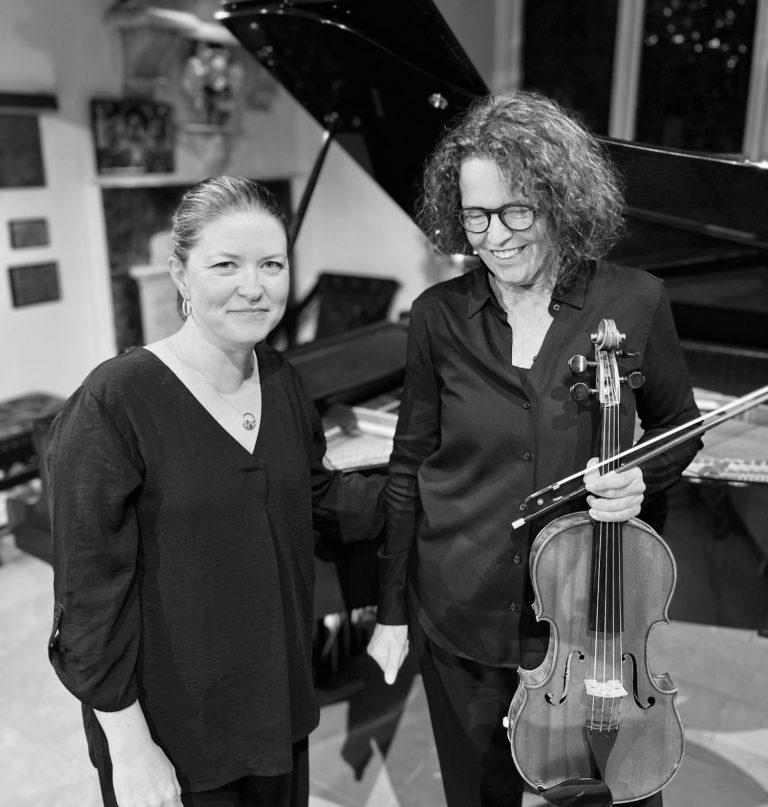
The Artists
Margrit Hasler
Margrit has enjoyed an extensive career in classical music, playing with some of the greatest conductors such as Solti, Haitink and Mehta. She has worked in numerous orchestras including the Royal Opera House, Britten Sinfonia and La Scintilla, accompanying Cecilia Bartoli on international tours. As a member of Philharmonia Zurich she also followed her passion for chamber music, performing many concerts with the principals. She has always been interested in many styles of music and this led her to actively explore other scenes. She studied improvisation in New York and took part in string camps in the US, learning bluegrass and other roots repertoire. She toured the UK with two contemporary jazz groups, Mark Lockheart’s ‘Ellington In Anticipation’ and Chris Batchelor’s ‘Zoetic’. These experiences have all provided inspiration for her project for solo viola with loop pedals, reflecting her immersion in these different musical traditions.
Rosie Richardson
Since graduating with a Masters in solo performance from the class of Professor Joan Havill at the Guildhall School of Music and Drama, Rosie has become well known for her work as a collaborative pianist. In this capacity, Rosie has given London recitals at Milton Court, the Wigmore Hall, the Purcell Room, Bridgewater Hall and the 1901 Arts Club in addition to music societies around the country. Overseas engagements have taken her across Europe and to the USA. Alongside this work, Rosie is ordained in the Church of England and is currently Associate Vicar at St. Paul’s Knightsbridge, where she enjoys the variety of being a priest and pianist.