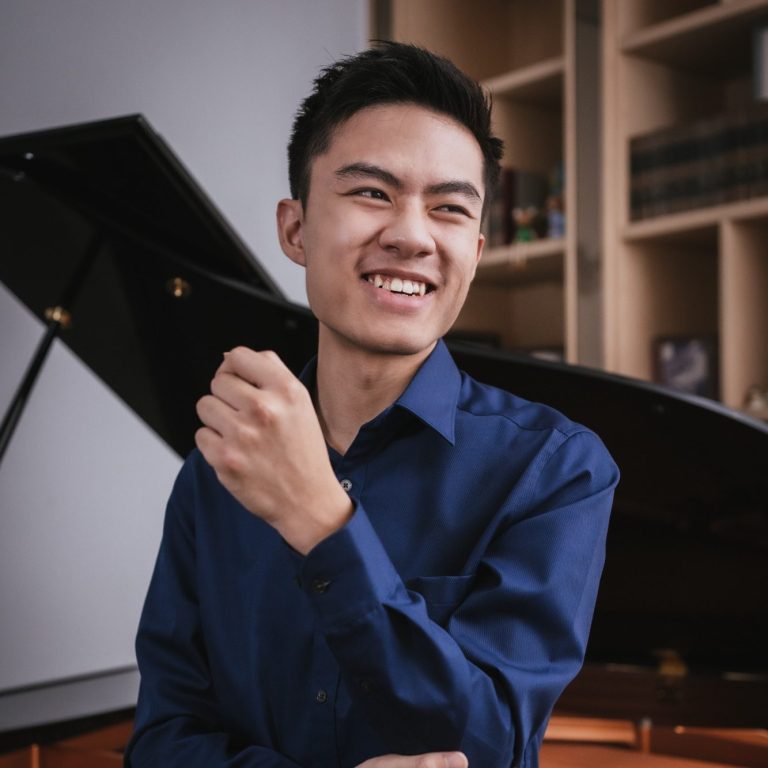
Hugh MacKay, Cello & Julian Chan, Piano
December 5th, 2025
The Programme
Hugh Mackay’s programme sets out to commemorate the 50th anniversary of the passing of Benjamin Britten. His programme includes the composer’s Sonata written for Russian cellist Rostropovich, together with Sonatas by Beethoven and Frank Bridge. A really thrilling programme.
Ludwig van Beethoven (1770-1827)
Sonata for Cello and Piano, no.5 in D major, Op.102 no.2
- Allegro con brio
- Adagio con molto sentiment d’affetto – Attaca
- Allegro – Allegro fugato
Edward Benjamin Britten (1913-1976)
Sonata for Cello and Piano in C major
- Dialogo. Allegro
- Scherzo-Pizzicato. Allegretto
- Elegia. Lento
- Marcia. Energico
- Moto perpetuo. Presto
Interval – 20 minutes
Frank Bridge (1879-1941)
Sonata for Cello and Piano in D minor, H125
- Allegro ben moderato
- Adagio ma non troppo – Molto allegro e agitato – Adagio ma non troppo – Allegro moderato
Programme Notes
This year commemorates 50 years since the passing of one of our most distinguished and famous composers, Benjamin Britten. It is for this reason that this evening’s performers have chosen Britten’s Cello Sonata and the Sonata by his first, and most important teacher, Frank Bridge. Britten wrote 5 works for the Russian cellist, Mstislav Rostropovich – the Sonata in C, the Cello Symphony and 3 solo Suites. Britten’s admiration for the Russian’s playing stems from a performance of Shostakovich’s 1st Concerto which he heard at the Royal Festival Hall in 1960. Britten was sharing a box at the RFH with the composer. Thus began a famous and fruitful friendship between Britten and the 2 Russians.
The idea for a new work came from Rostropovich himself when he pleaded with Britten for a new work. During the composition process, Britten corresponded with the ‘cellist, fearing his writing was lacking, “I may have made some mistakes”, “the pizzicato movement will amuse you; I hope it is possible!” The first performance took place at the Aldeburgh Festival in July 1971 with Rostropovich and Britten at the piano.
To we music students in the 1960’s and 70’s, the name Frank Bridge meant only that he was Britten’s first and most important teacher. His own music was almost totally unknown; it was mostly due to the efforts of his famous pupil that his works began to appear in concert programmes, notably such orchestral pieces as The Sea and Enter Spring. Bridge wrote is Cello Sonata between 1913 and 1917. He was terribly affected by the First War which he saw as futile and totally inhumane. He would wander around Kensington near his home at night-time, unable to sleep. From this time came the ideas for the slow movement of the Sonata. After WW1 Bridge’s musical language developed into realms approaching atonality, placing him apart from his English contemporaries. His pacifist ideals he passed onto his famous pupil and that resulted in one of the finest of all 20th century choral masterpieces, the War Requiem. Britten also wrote a work for String Orchestra, “Variations on a Theme of Frank Bridge”.
The Artists
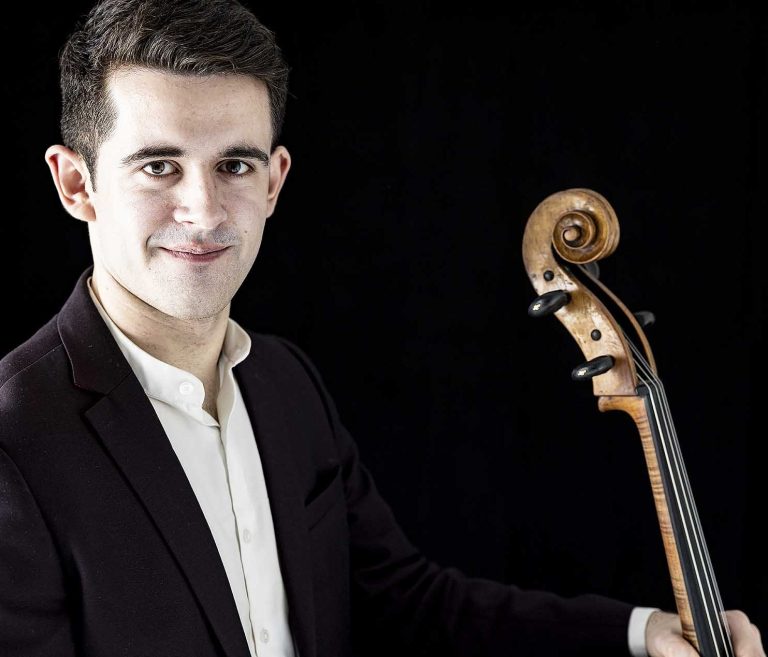
Hugh Mackay
Cellist Hugh Mackay has been a chamber music scholar at the Landesstiftung Villa Musica since 2024. A winner of the Suggia Gift and a former Mozart Gesellschaft Dortmund Scholarship holder, Hugh was a semi-finalist in the 2024 International Bach Competition in Leipzig. He has performed internationally at leading venues including Wigmore Hall, the Elbphilharmonie, the Dortmund Konzerthaus, and the Palace of Versailles, establishing himself as one of Scotland’s most distinctive young cellists.
An avid chamber musician, Hugh has performed at numerous festivals including the West Wycombe Chamber Music Festival under the direction of Lawrence Power, the NUME Festival with Vlad Stanculeasa, and Mendelssohn on Mull alongside the Doric String Quartet. Recently, he was invited to the Open Chamber Music sessions at IMS Prussia Cove. Hugh is a founding member of Ensemble Jackalope, who are Young Artists in Residence at Britten Pears Arts this season.
In addition to his solo and chamber work, Hugh is increasingly active as an orchestral leader, having performed as Guest Principal Cellist with the Scottish Chamber Orchestra, the Royal Northern Sinfonia, and the Anonimi Chamber Orchestra.
Born in the Scottish Borders in 2000, Hugh studied at St Mary’s Music School in Edinburgh and at the Royal Academy of Music, London, where he trained with Hannah Roberts, John Myerscough, and Jonathan Manson. He was awarded the Yadegar-Hall Award, the inaugural LSO Conservatoire Scholarship, and won scholarships from the Cross Trust, Caird Trust, Countess of Munster Trust, and Help Musicians UK.
Julian Chan
Rapidly developing a reputation as one of the most innovative pianists of his generation, Julian Chan has given performances at numerous prestigious venues across Europe and Asia, including Wigmore Hall, Southbank Centre, Nanjing Poly Theatre, and Palau de la Música Catalana. Performing music by a particularly diverse range of composers, he has given alluring recitals featuring works by figures from Sweelinck to Messiaen, from Alkan to Rzewski, unifying these various styles in a captivating manner.
Julian has performed with numerous artists of international renown, including Anthony Marwood, John Myerscough, Dénes Várjon, Richard Lester, Dale Barltrop, and Charlie Lovell-Jones; distinguished conductors with whom he has performed include Jessica Cottis, Dominic Grier, Ryan Wigglesworth, Ben Glassberg, Jonathan Berman, and John Gibbons. Recently, Julian has been awarded First Prize and Sonata Prize at the Nanyang International Music Competition, Singapore, Second Prize at the Jazeps Vitols International Piano Competition, Latvia, the Royal Over-Seas League Collaborative Piano Award, First Prize at the Norah Sande Award, and First Prize at the Coulsdon and Purley Festival with his performance of Rachmaninoff’s Third Piano Concerto.
A passionate composer and performer of new music, Julian has collaborated with eminent composers such as Hans Abrahamsen, Anna Thorvaldsdottir, Jörg Widmann, Deborah Pritchard, Elena Langer, and Peter Seabourne. Julian had his first book of compositions published at age 6, earning him the title of Malaysia’s Youngest Composer.
In 2024–25, Julian was recipient of the Aud Jebsen Fellowship at the Royal Academy of Music, where he previously studied with Ian Fountain and Michael Dussek. He is graciously supported by the Royal Over-Seas League and the Keyboard Charitable Trust.