
Klein Trio with Doroti Vinkler (flute), Chamber music & Premier of Flute Quartet by Alistair Jones
December 19th, 2025
The Programme
The Klein Trio of three string players has already built up an enviable reputation in concerts in Europe and the UK, and appearance on the BBC. They are famous for their innovative programming. For this concert they are joined by Flautist, Doroti Vinkler, for the premier of the Flute Quartet by Alistair Jones.
Freya Walley-Chen
- 'Conjure'
Caroline Shaw
- 'Limestone & Felt' (va/vc duo)
Alistair Jones
- Fantasy Quartet (Flute and String Trio)
Errollyn Wallen
- 'Making Hay'
Sophia Gubaidulina
- String Trio
Interval - 20 minutes
Bach
- Goldberg Variations (Arranged for StringTrio by Dimitry Sitkovetsky)
Programme Notes
It is a rare treat for us at the CICS to have a professional chamber group with an international reputation. It also gives me lovely opportunity to have a relatively new work performed for the first time. The Klein Trio has as its driving force a policy of programming contemporary works, here to be found in the first part of the programme.
Freya Waley-Cohen is British-American composer based in London. She has a large compendium of works ranging from stage, orchestral, Chamber, to vocal and choral pieces. “Conjure” for string trio was composed in 2019, a commission by the Wigmore Hall, where it was premiered by members of the Albion Quartet,
Caroline Shaw is an American composer, violinist and singer. She won the 2013 Pulitzer Prize for Music for her choral piece, “Partita for 8 Voices” and in 2022 the Grammy Award for Best Contemporary Classical Composition and in 2025 the Grammy for Best Chamber Music. “Limestone & Felt” was premiered in 2012. The composer writes, “ In limestone & felt, the hocketing pizzicato and pealing motivic canons are part of a whimsical, mystical, generous world of sounds echoing and colliding in the imagined eaves of a gothic chapel. These are contrasted with the delicate, meticulous, and almost reverent placing of chords that, to our ears today, sound ancient and precious, like an antique jewel box”. Make of that what you will!
My Fantasy Quartet for Flute and String Trio was written at the request of a flautist friend who played with 3 string players. He said they needed something new. I was intrigued by this combination and sat down and immediately wrote a high A minor chord in close spacing with a high cello A as it base. This is modal sounding music is the opening of the 6-minute piece. Fantasies work in sections, and this quartet is in that simple form. Each section has new melodic material, punctuated by the recurrence of versions of the opening A minor sequence.
Errollyn Wallen, a Belize-born composer, was appointed by HM King Charles to the position of Master of the King’s Music in 2024. Her compositional style is difficult to pinpoint, but her list of works is many and varied. Her orchestral work “The Elements”, a BBC commission, was premiered at the opening of the 2025 Proms. Her trio, “Making Hay” was commissioned by the Nova Linea Foundation for the Black Oak Ensemble.
Sofia Gubaidulina (1931-2025), was a major innovative force in music. AS a composer in Soviet Russia she had the distinction of being investigated by the KGB. Despite that disfavour, her works have been performed all over the world. Her works are numerous including chamber, orchestral and choral pieces. Her music has been described as exploring the tensions between Western and Eastern Music. She described her music as bringing legato, that is, a sense of “connected flow into the fragmented staccato of life.” Her String Trio was written in 1988, a commission from Radio France and dedicated to the memory of the writer Boris Pasternak.
The Goldberg Variations – note. ©2008, Alistair Jones
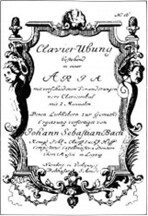
The four parts of the Clavierübung (Keyboard Studies) were written during the years of Bach’s tenure of the post of Kantor at the Thomaskirche in Leipzig. Parts 1 and 2 contain the Partitas, Italian Concerto and the French Overture. Part 3 comprises a set of Chorale Preludes for Organ, framed by a Prelude and Fugue in E Flat. Part 4 contains one work only, the Goldberg Variations, published in 1741.
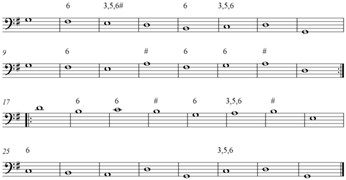
The baroque scholar Manfred Bukofzer says of this work, “The Goldberg Variations sum up the entire history of baroque variation. Written on a chaconne bass in saraband rhythm they are arranged in the strict order of two free variations and one in canon”. Indeed it is important to note that the variations are built not on the melody of the opening Aria, but on its bass line and accompanying chord progression. 3 variations (15, 21 and 25) are in G minor.
The canons (every 3rd variation) follow an ascending order. Var. 3 is at the unison, Var. 6 is at the 2nd (the second entry being the interval of a 2nd above the first), Var. 9 is at the 3rd, Var. 12 is at the 4th, Var. 15 is at the 5th and so on until we reach Var. 27 at the 9th. Variation 30 is a Quodlibet on some German tunes, well known in Bach’s day.
Johann Nikolaus Forkel, in his biography of Bach published in 1802, 60 years after the composition of the Variations, attributed the following story to the creation of this monumental, masterly creation for the keyboard. Not all scholars agree with the facts.
[For this work] we have to thank the instigation of the former Russian ambassador to the electoral court of Saxony, Count Kaiserling, who often stopped in Leipzig and brought there with him the aforementioned Goldberg, in order to have him given musical instruction by Bach. The Count was often ill and had sleepless nights. At such times, Goldberg, who lived in his house, had to spend the night in an antechamber, so as to play for him during his insomnia ... Once the Count mentioned in Bach's presence that he would like to have some clavier pieces for Goldberg, which should be of such a smooth and somewhat lively character that he might be a little cheered up by them in his sleepless nights. Bach thought himself best able to fulfill this wish by means of Variations, the writing of which he had until then considered an ungrateful task on account of the repeatedly similar harmonic foundation …... Bach was perhaps never so rewarded for one of his works as for this. The Count presented him with a golden goblet filled with 100 louis d’or.
- Aria – in G major
- Variatio 1 – a 1 Clav. (on 1 Keyboard)
- Variatio 2 – a 1 Clav.
- Variatio 3 – Canon all’ Unisono a 1 Clav.
- Variatio 4 – a 1 Clav.
- Variatio 5 – a 1 ovvero 2 Clav. (on 1 or 2 Keyboards)
- Variatio 6 – Canone alla Seconda a 1 Clav.
- Variatio 7 – a 1 ovvero 2 Clav.
- Variatio 8 – a 2 Clav. (on 2 Keyboards)
- Variatio 9 – Canone alla Terza. A 1 Clav.
- Variatio 10 – Fughetta. a 1 Clav.
- Variatio 11 – a 2 Clav.
- Variatio 12 – Canone alla Quarta
- Variatio 12 – a 2 Clav.
- Variatio 13 – a 2 Clav.
- Variatio 14 – a 2 Clav.
- Variatio 15 – Canone alla Quinta (in moto contrario) a 1 Clav. (In G minor)
- Variatio 16 – Ouverture – a 1 Clav.
- Variatio 17 – a 2 Clav.
- Variatio 18 – Canone alla Sesta – a 1 Clav.
- Variatio 19 – a 1 Clav.
- Variatio 20 – a 2 Clav.
- Variatio 21 – Canone alla Settima (G minor)
- Variatio 22 – Alla breve
- Variatio 23 – a 2 Clav.
- Variatio 24 – Canone all’Ottava – a 1 Clav.
- Variatio 25 – a 2 Clav. ( G minor)
- Variatio 26 – a 2 Clav.
- Variatio 27 – Canone alla Nona – a 1 Clav.
- Variatio 28 – a 2 Clav.
- Variatio 29 – a 1 Clav ovvero 2 Clav.
- Variatio 30 – Quodlibet – a 1 Clav
- Aria da Capo e Fine
Programme Notes Copywrite Alistair Jones, 2025
The Artists
Trio Klein
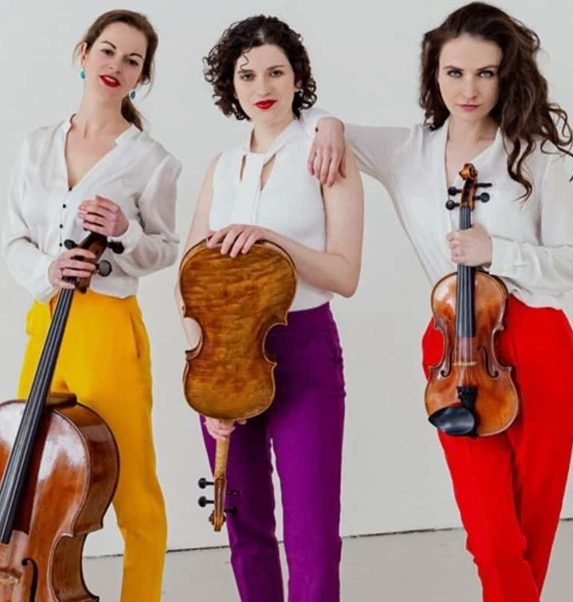
Trio Klein are dedicated to innovative programming, and enjoy a busy and diverse international schedule. Their groundbreaking ‘Trio Klein’s 80s Night’ programme, which places classical trios alongside arrangements of minimalist works and pop songs from the same decade was broadcast live on BBC Radio 3; elsewhere they have been featured in Classical Music Magazine, The Strad and on RAI TV, and were Artists in Residence at University of Surrey 2023/2024.
Violinist Kamila Bydlowska, violist Shiry Rashkovsky and cellist Ella Rundle bring with them a wealth of musical and artistic experience including numerous international festival engagements such as Prussia Cove Open Chamber Music, disc recordings for NMC, Toccata Classics and October House Records, and appearances on BBC Radio 4 and New York’s WQXR.
To read more about this exciting Trio visit their website here.
Doroti Vinkler
For this concert Trio Klein are joined by Flautist, Doroti Vinkler, for the premier of the Flute Quartet by Alistair Jones.