Khrystyna Mykhailichenko - October 17th, 2025
The Programme
We give a very warm welcome to Khrystyna from Ukraine who is now a student at London’s Royal Academy. We will have a programme of Sonatas by Domanico Scarlatti, music by Bach and Chopin, and one of Schubert’s finest sonatas – in A major, D.959. A programme of the piano’s finest music.
Bach (Busoni)
- Chorale 'Nun Komm Der Heiden Heiland' & 'Nun Freut Euch, Lieben Christen'
Scarlatti
- Sonata in A flat Major, K.127
- Sonata in F Minor, K.466
- Sonata in A Major, K.101
Chopin
- Nocturne no.8 in D flat Major, op.27
- Polonaise in F sharp Minor, op.44
Interval - 20 minutes
Schubert
Piano Sonata in A Major, D.959
- Allegro
- Andantino
- Scherzo: Allegro Vivace - Trio: Un poco più lento
- Rondo: Allegretto - Presto
Programme Notes
This evening’s programme is a sheer delight with acknowledged masterpieces coupled with 2 curiosities. Busoni was a famous, like many others, as both a pianist and a composer. He also had a passion for the music of J.S.Bach, many of whose works he transcribed for the modern piano. His piano version of the Chaconne for unaccompanied violin is most famous. This evening, we have transcriptions of 2 chorales from Bach’s cantatas. Bach’s harmonisations of chorale melodies are held up to music students as supreme examples of the art of 4-part vocal harmony. Busoni’s transcriptions decorate these a bit further!
I have written elsewhere concerning the 550 keyboard sonatas of Domenico Scarlatti. They are all gems of musical ingenuity and supreme examples of advanced teaching materials. I can only say that his pupil, Princess Maria Barbara (later Queen) of Spain must have become one hell of a harpsichordist! Domenico also composed operas and church music. One would love to have been a fly on the wall in 1709 when Handel’s patron, Cardinal Ottoboni arranged a friendly competition between Handel and Scarlatti. Handel was judged the finer organist while Scarlatti the superior harpsichordist. I am trying to think of a contemporary battle – Britten versus Copland? Stravinsky versus Schoenberg? OR – and this leads us to the next composer in the programme, Chopin versus Liszt!
Chopin wrote almost solely for the piano. His oeuvre contains 2 piano concertos, 3 piano sonatas, some chamber music and songs and then a host of solo piano compositions, all finely crafted requiring the highest possible technique and musicianship in performance. Such are the Nocturnes and Polonaises. The composer published 9 sets of pieces entitled nocturne, literally “night pieces”. Wikipedia’s definition is, “a piece of music, especially for the piano, that is dreamy or pensive or evocative of the night”. The Irish composer, John field, pioneered the form and Chopin took it up and developed it further. While “dreamy” may be appropriate for the D flat Nocturne we are to hear this evening, there are many in Chopin’s output that have a disturbing, dramatic feeling about them. Likewise, the Polonaise. In origins an aristocratic dance or processional piece, Chopin used it as a medium for a variety of musical thoughts. This evening’s example is F sharp minor, a dramatic key if ever there was one, was described by the composer’s friend, Franz Liszt as “a dream poem of the lurid hour that precedes the hurricane – with a convulsive shudder at the close.” In the middle there is a section in A major, marked “Tempo di Mazurka” and Doppio movimento (double time) – very much a calm before a furious, virtuosic storm.
Schubert’s last 3 Piano Sonatas, written in the year of his death, 1828, are considered now as the high point of his many solo piano works. 1828 saw a remarkable outpouring of music – 3 Piano Pieces, D946, the Mass in E flat, the String Quintet and his Schwanengesang songs and the 3 final Sonatas. All this while suffering from syphilis, a disease incurable at that time. The final Sonata was completed on September 26, and 2 days later the composer performed all 3 sonatas to a gathering of friends. The composer died on November 19th. The following year, Schubert’s brother Ferdinand sold the manuscripts of the sonatas to Diabelli, who published them 10 years later, with a dedication to Robert Schumann! Originally, Schubert planned the dedication to Hummel, whom he much admired, but was dead by the time of publication. Diabelli chose Schumann, who had written much in praise of Schubert – very strange. The form of all 3 final sonatas owes much to Beethoven, whom Schubert venerated.
Programme Notes Copywrite Alistair Jones, 2025
The Artist
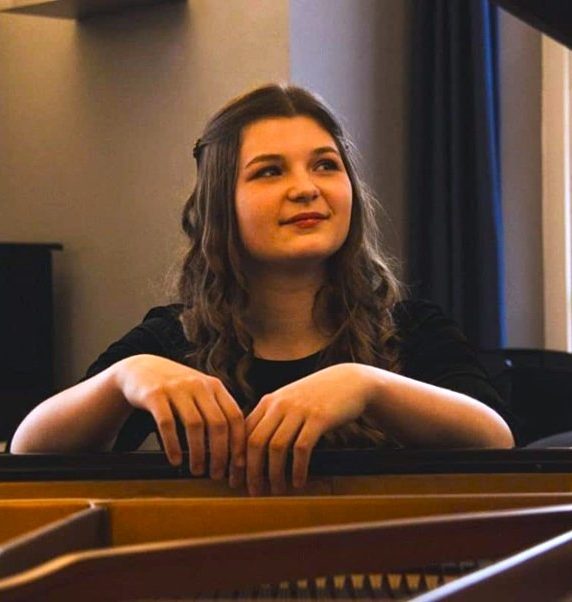
Khrystyna Mykhailichenko is a young Ukrainian pianist, born in Simferopol and who has been called a "musical prodigy".
After winning her first contest at the age of five, she has been a first-prize winner in a number of national and international competitions. In 2016, at the age of 10, she was awarded first prize in two categories of the International Competition for Young Pianists in Memory of Vladimir Horowitz.[3] In the same year, she was awarded first prize in her age category in the inaugural international "Merci, Maestro!" competition for young pianists in Brussels. She has performed over 40 times with orchestras and has given solo recitals in Paris, New York, Washington, Fort Lauderdale, Brussels, Vienna, Istanbul, and Bayreuth.
After Crimea was invaded and annexed in 2014, Khrystyna and her family moved to Irpin, near Kyiv. After Ukraine was invaded by Russian forces in February 2022, Khrystyna, her mother and her younger sister fled to Krakow in Poland and lived there for three months. She then emigrated with her mother and sister to the United Kingdom in 2022 and lived with a family in Corbridge.
In 2023, she was awarded a full bursary for a four-year degree course to study piano at the Royal Academy of Music in London. Jonathan Freeman-Attwood, the Royal Academy’s principal, said: “Khrystyna Mykhailichenko is an extraordinary talent of rare maturity for her age."