
Milen Manoj Earath, Piano
February 13th, 2026
The Programme
Milen Manoj Earath was introduced to the piano at the age of 9, by 14 he was a Licentiate of Trinity College, London (LTCL) with distinction. It will be a rare treat to hear a player of such prodigous talent.
Ludwig van Beethoven (1770-1827)
- Piano Sonata no.3 in C major, Op.2, no.3
- Allegro con brio
- Adagio
- Scherzo: Allegro
- Allegro assai
Ferencz Liszt (1811-1886)
- Harmonies du Soir, S.139 no.11 (from Transcendental Études)
Alexander Nikolayevich Scriabin (1872-1915)
- Piano Sonata No.5, Op.53
- One single movement in several section
Interval – 20 minutes
Ferencz Liszt (1811-1886)
- Piano Sonata in B minor – S.178
- Composed in one extended movement and subdivided into smaller sections. The tempo changes are many – giving the list would be long and confusing and may mar your enjoyment of this, one of Liszt’s finest masterpieces. Read the programme note!
- Composed in one extended movement and subdivided into smaller sections. The tempo changes are many – giving the list would be long and confusing and may mar your enjoyment of this, one of Liszt’s finest masterpieces. Read the programme note!
Programme Notes
This evening’s programme could be seen as a brief history of the development of the genre, the Piano Sonata. Take a look at the dates of the composers and you will see they are linked. Liszt was born in Beethoven’s lifetime and, similarly, Scriabin was born 14 years before the death of Liszt. All 3 were notable pianists. In terms of their piano compositions, there is a line of development. Beethoven’s Opus 2 Sonatas are early in his career and the beginning of the long journey to his famous final 3, opus 109, 110 and 111. Liszt’s famous B minor takes the form of the piano sonata into new realms both technically and musically. Scriabin, like Liszt, was a piano virtuoso as well as a composer. His 5th Sonata is, similarly, in one movement in many sections and linked to extra musical stimuli.
Beethoven’s 3 Opus 2 Piano Sonatas, published in 1796 when the composer was 26, are dedicated to the composer Haydn. Haydn (and Mozart) were the pre-eminent composers on keyboard compositions in the latter half of the 18th century. The young Beethoven arriving in Vienna applied to Mozart for composition lessons. Mozart was too busy and recommended Haydn. Haydn said “yes”, but the relationship was a difficult one. Beethoven’s first sonatas show an adventurous and enquiring mind. He develops further the form and musical content of the sonata form. The sonatas also make greater technical demands of the performer. In particular, this evening’s C major Sonata features fast passages, wide-spanning chords and rapid dynamic changes, showing the influence of the pianism required of Mozart’s piano concertos.
Liszt’s Transcendental Études, published in 1852, were the final development of earlier versions of 1826 and 1837. Famous for their difficulty, they were dedicated to Carl Czerny, at one time Liszt’s teacher and himself a composer of hundreds of études (studies). In their final published version, Liszt added titles to 10 of the 12 pieces. This evening’s Harmonies du Soir (Evening Harmonies) is number 11 of the set. It has been described thus: this étude is one of the most poetical of the collection. It is a study in harmonies, broken chords played in quick succession, full octave jumps, chromatic harmonies, chord variations, interlocking hands, bravura, massive chords and pedalling.
Alexander Scriabin might be described as one of music’s eccentrics. He was a pianist of virtuosic ability and as a composer an innovator. Early he was influenced by Chopin, but later, independent of the German composer Schoenberg, he experimented with dissonance and atonality. The Russian writer Leo Tolstoy described Scriabin’s music as “a sincere expression of genius.” His 5th Piano Sonata is in one movement, and the composer wrote of it to his friend Morozova, “Today I have almost finished my 5th Sonata. It is a big poem for piano, and I deem it the best composition I have ever written. I do not know by what miracle I accomplished it.” At the head of the Sonata, he placed in Russian this text:
I call you to life, O mysterious forces!
Drowned in the obscure depths
Of the creative spirit, timid
Shadows of life, to you I bring audacity
Few musical works have had so much written about then as Liszt’s one movement Sonata in B minor. It was completed in 1853 while the composer was living in Weimar. Published the following year, it was premiered in Berlin in 1857 by the composer’s son-in-law, Hans von Bülow, and caused a scandal. It is dedicated to Robert Schumann. Clara Schumann, one of the finest pianists of the age, disliked the work, describing it as “a blind noise …. it is really too awful.” The point is that the music and its one movement form were too far ahead of time to be appreciated. The first audience could not understand what was going on. Liszt was one of the originators of “programme music”, that is, music based on extra musical ideas. The most popular theory about the B minor sonata is that it was based on the Faustian legend of Faust, Gretchen and Mephistopheles. Pianist Claudio Arrau was a student of one of Liszt’s own students and said that the Faust story was the one they all believed in. The composer, however, never admitted to any particular programme for this wonderful work. As you will hear, the music is full of themes and motifs – they might tell a story, or they might just make up a masterful and glorious one movement Sonata. As audience, you can make up your own minds – and enjoy!
Programme Notes Copyright Alistair Jones, 2026
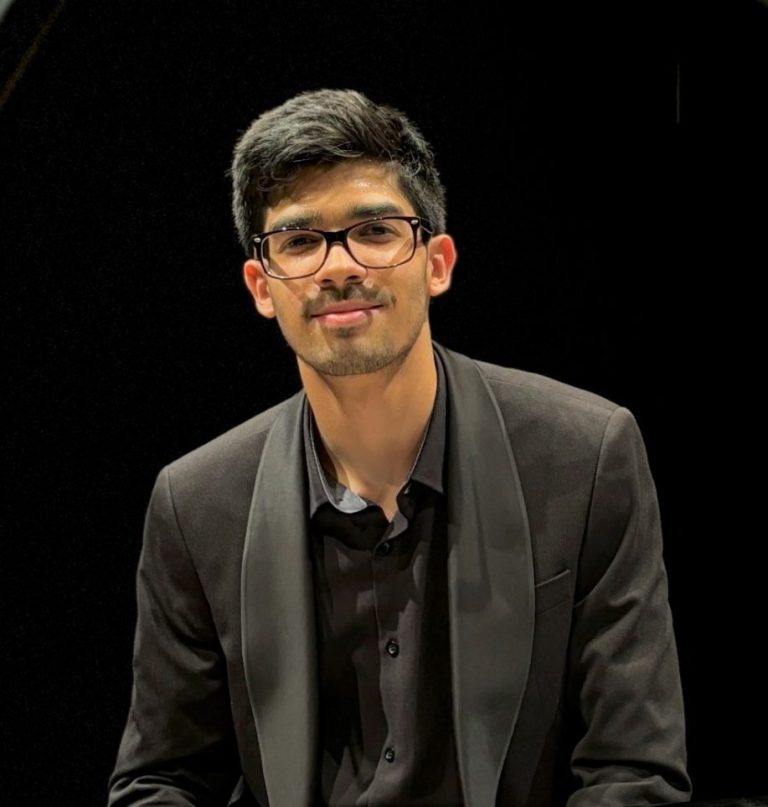
The Artist
Milen Manoj Earath
Milen Manoj Earath was born in the southern Indian state of Kerala. Milen comes from a family with no musical background. His father Manoj Bhaskaran Earath, an Indian national and mother Alena Vladimirovna Earath, a Russian national, are both doctors. During his childhood, he was interested in sports, kung-fu, and other extra-curricular activities, especially at school. Milen excelled in academics, winning prizes in recitation, elocution and storytelling in primary school.
Milen's introduction to the world of classical piano music happened during his 3rd grade school vacation, while he visited his grandparents in Russia. They took him to a concert at a music school nearby where he first saw and heard a grand piano. He went for piano lessons in that music school for the next two weeks, during which he learnt to play Beethoven's Fur Elise and Marmot.
It was after the school vacation that Milen joined a music school in his hometown Thrissur on June 1, 2010. In May 2011, Milen started Initial Grade Piano of Trinity College of London. In a span of 1.5 years, by December 2012, he had completed the 8 grades in Pianoforte with distinction.
He appeared for Associate of Trinity College, London (ATCL) in December 2013 and passed with distinction. In December 2014, he passed Licentiate of Trinity College, London (LTCL) with distinction. In January 2015, Milen was certified with Fellowship of Trinity College, London (FTCL) in Piano Performance. The time of 4.5 years taken by Milen, who is also the youngest Indian to do so, for completing the 8 grades and the 3 diplomas of Trinity College, London is considered to be one of the shortest.
Milen's first exposure to a piano competition was at age 12 in the 2013 MusiQuest, an all-India piano competition in Pune. He won first place in the advanced division for ages up to 25, winning an acoustic piano and a scholarship for a summer camp in the International Institute for Young Musicians in Kansas. In 2014, he was a semi-finalist and the winner of the "Audience Favorite Prize" at "Conbrio" Mumbai, a national level piano competition for ages up to 35.
After Musiquest, he was invited for piano masterclasses Heribert Koch, president of the European Piano Teachers Association (EPTA), Germany, who had started to give him advice over internet. Milen has attended many intensive piano masterclasses with Prof. Koch since 2014, for which he travelled to Germany for short periods. While in India, Milen continued his work mostly by himself and through occasional Skype classes. Starting in 2014, Milen had multiple concerts in Germany, Russia, Belgium and Italy. On January 24, 2016, Milen had his first solo recital, which was held at Schloss Burgau, Germany. His orchestral debut took place in Germany on October 16, 2016, where he performed Mendelssohn’s Piano Concerto no.1 in G minor.
Milen was awarded the national child award for exceptional achievements in the field of music by President of India Pranab Mukherjee on November 14, 2016, at Rashtrapathi Bhavan. His first large-scale solo recital in India was held on April 28, 2017 at the National Centre for Performing Arts in Mumbai.
On November 10, 2017, Milen performed for Queen Mathilde of Belgium, at the Mehli Mehta Music Foundation, Mumbai. On February 3, 2018, Milen performed Liszt’s Piano Concerto No.2 accompanied by Collegium Musicum Julich, with conductor Peter Sauerwein at the Gymnasium Zitadelle in Julich. In June 2024, Milen completed his 5 year Specialist diploma in piano performance (equivalent to British Bachelors degree - Honors) with Prof. Tatiana Zelikman at the Gnesin Russian Academy of Music, Moscow. He graduated with First-Class Honors. Currently, Milen is doing his Master of Performance in piano at the Guildhall School of Music and Drama, London with Prof. Ronan O’Hora. He is also currently a recipient of scholarships from Steinway & Sons, Leverhulme Arts Trust and the Jesse Wakefield Bursary.